There is a corner of Normandy that almost nobody from outside France has driven through, and it is the one where our money goes furthest.
The south of the Manche — the Mortainais, and the country around Saint-Hilaire-du-Harcouët and Sourdeval — is deep bocage: hedged fields, sunken lanes, granite villages, woods and river valleys. It has a gorge with two waterfalls in it. It is half an hour from Mont-Saint-Michel, forty minutes from the beaches on the west coast, and a little over an hour from three ferry ports.
It is also where we have more building plots than anywhere else we work. Here is what is actually there.
Where it is
Take the bottom left-hand corner of Normandy, where the Manche meets the Orne and Mayenne. Avranches and the bay of Mont-Saint-Michel are to the west, Vire to the north, Domfront to the south-east.
The landscape is not the flat Normandy of the postcards. This is the edge of the Armorican massif, the same granite that makes Brittany, and the ground rolls properly. The Mortain area contains some of the highest land in western France outside the Alps and Pyrenees — modest by mountain standards, but it means views, valleys and real walking rather than beet fields.
Mortain-Bocage
The town sits above a gorge cut by the Cance, and the gorge is the thing people remember.
La Grande Cascade drops around twenty-five metres over the granite and is a ten-minute walk from the centre of town. La Petite Cascade, upstream, is smaller and arguably prettier, in a cleft of mossy rock that stays cool in August. Paths run along both sides of the valley and link up with a wider network through the woods.
Above the town, the Petite Chapelle sits on a rock with a view that on a clear day reaches Mont-Saint-Michel, thirty-odd kilometres away across the bay. The Abbaye Blanche, a twelfth-century Cistercian house at the edge of the town, is one of the most complete small monastic sites in Normandy and still has its cloister.
Mortain itself is a working town rather than a show one — around two thousand people in the old commune, with shops, a weekly market, a secondary school, doctors and a pharmacy. It merged with Le Neufbourg in 2016 to become Mortain-Bocage.
It also has a war history that is not widely known outside France. In August 1944 the Germans counter-attacked here to try to cut off the American breakout, and a battalion of the 30th Infantry Division held the high ground at Hill 314 above the town for six days, surrounded and resupplied by air. The town was largely destroyed. There is a memorial on the hill, and the view from it is the reason the hill mattered.
The towns around it
Saint-Hilaire-du-Harcouët, fifteen minutes south, is the practical centre of the area: supermarkets, a proper high street, schools, medical services, and a weekly market that draws people in from three departments. If you want the convenience of a town without living in one, this is the town you will be using.
Sourdeval, north of Mortain on the Sée, is smaller and sits in the high bocage with long views. Barenton, east towards the Orne, is cider and perry country and has the Maison de la Pomme et de la Poire, a museum and working orchard in an old farm that is far more interesting than it sounds. Ger has a pottery museum on the site of a village that made earthenware for centuries.
Villedieu-les-Poêles, half an hour north, is the copper town. They have been beating copper pans here since the Middle Ages and still do, in workshops you can walk into. It also has the last working bell foundry in France — Cornille-Havard has cast bells for cathedrals around the world, including Notre-Dame de Paris, and you can watch them being made. The town is handsome grey granite and well worth the drive.
Vire, twenty-five minutes north-east in Calvados, is the regional market town and the home of andouille de Vire, the smoked chitterling sausage that Normandy takes very seriously.
Domfront, in the Orne, is a medieval hill town with a ruined keep and half-timbered streets, surrounded by the perry orchards of the Domfrontais.
The Sélune, and something genuinely remarkable
Running along the southern edge of the area is the Sélune, and something has happened to it that is worth knowing about.
For most of the last century the river was blocked by two large hydroelectric dams. The Vezins dam, thirty-six metres high, was dismantled in 2020, and La Roche-qui-Boit followed — the largest dam removal ever carried out in Europe. The river ran freely again from late 2022.
What has happened since has surprised even the people who argued for it. Atlantic salmon, sea lamprey and eel have come back. The water temperature has dropped. Vegetation has returned to banks that were underwater for ninety years, and a long drowned valley has reappeared as a wooded river gorge.
It is one of the more interesting pieces of landscape in Europe right now, it is on the doorstep, and in twenty years' time it will be one of the reasons people want to live here.
The coast and Mont-Saint-Michel
Mont-Saint-Michel is around half an hour from Mortain and twenty-five minutes from Saint-Hilaire. Living this close to it changes it from a day trip into somewhere you take visitors on a wet Tuesday in November, when it is empty and far better.
The bay has the highest tides in Europe. The sea goes out several kilometres and comes back quickly, and the guided walks across the sands — barefoot, with a licensed guide, and never alone — are one of the real experiences of Normandy.
Avranches, thirty-five minutes west, sits above the bay and holds the Scriptorial, the museum built to display the medieval manuscripts from the Mount's own library. It is a serious collection and an unexpectedly good museum.
Beyond it, the west coast of the Manche is about forty-five minutes: long sand beaches at Jullouville, Carolles, Hauteville and Agon-Coutainville, and Granville, the walled town on its headland with a working fishing port, a thalassotherapy spa, Christian Dior's childhood house above the sea, and a February carnival that closes the place for five days. Fast ferries run from Granville to Jersey and Guernsey in about an hour.
Outdoors
The Vélomaritime, the French section of EuroVelo 4, runs through the area with a signed stage between Saint-Hilaire-du-Harcouët and Mortain-Bocage, so you can ride from here to the coast on a marked route.
Beyond that there are marked footpaths everywhere — the gorge at Mortain, the Sée and Sélune valleys, the woods at Lande Pourrie. The Suisse Normande around Clécy, forty-five minutes north-east, has the climbing, the kayaking and the paragliding. There are lakes for fishing and swimming, and some of the quietest road cycling in France, because there is almost no traffic.
Eating and drinking
This is dairy country and unapologetic about it. Butter and cream from Isigny, both with protected status; the four great Norman cheeses — Camembert from the Orne, Livarot, Pont-l'Évêque and the heart-shaped Neufchâtel.
From the bay comes agneau de pré-salé, the salt-marsh lamb that grazes on grass covered by the tide and has its own appellation. It is one of the great French meats and it is produced within half an hour of your front door.
To drink, there is no wine and nobody minds. Cider is the everyday drink. Poiré du Domfrontais is perry from the orchards around Domfront, made from pears grown on enormous old trees, with its own appellation and quite unlike anything else — delicate, slightly sparkling, and made twenty minutes away. Calvados is the apple brandy, and pommeau — apple juice fortified with calvados and aged — is the gentler place to start.
Markets are the social institution here, and every town of any size has one. Saint-Hilaire-du-Harcouët has the big one for the area; Mortain, Sourdeval, Villedieu, Barenton, Avranches and Granville all hold their own. Days do shift, so check with the mairie or the tourist office rather than turning up hopefully — and go early, because the good stalls sell out.
The practical side
Getting home. Saint-Malo is roughly an hour and a quarter, Caen-Ouistreham about an hour and a half, and Cherbourg around two hours — three ferry ports within easy reach, which is more than almost anywhere else in France can offer. The Granville–Paris railway line stops at Villedieu-les-Poêles and Vire and reaches Paris Montparnasse in about three hours. Rennes, Caen and Nantes airports are all drivable.
Healthcare. Avranches, Vire and Saint-Lô have hospitals, with the regional teaching hospital at Caen. Saint-Hilaire-du-Harcouët and Mortain both have medical centres and pharmacies. As everywhere in rural France, doctor availability varies commune by commune — ask about the specific village rather than the department.
Schools. Villages have primary schools, Saint-Hilaire-du-Harcouët and Mortain have collèges, and there are lycées at Saint-Hilaire, Avranches and Vire. The system is free and good, and younger children are fluent inside a year.
Shopping. Supermarkets at Saint-Hilaire-du-Harcouët, Sourdeval, Villedieu and Vire, with the bigger retail parks at Avranches.
What it costs to build here
This is the part that brings people.
We have more plots in the southern Manche than in any other area we work — at Mortain-Bocage, Saint-Brice-de-Landelles, Saint-Martin-de-Landelles, Les Loges-Marchis, Romagny-Fontenay, Grandparigny, Moulines, Saint-Hilaire-du-Harcouët, Sourdeval, Le Fresne-Poret and Gathemo, with more across the wider department.
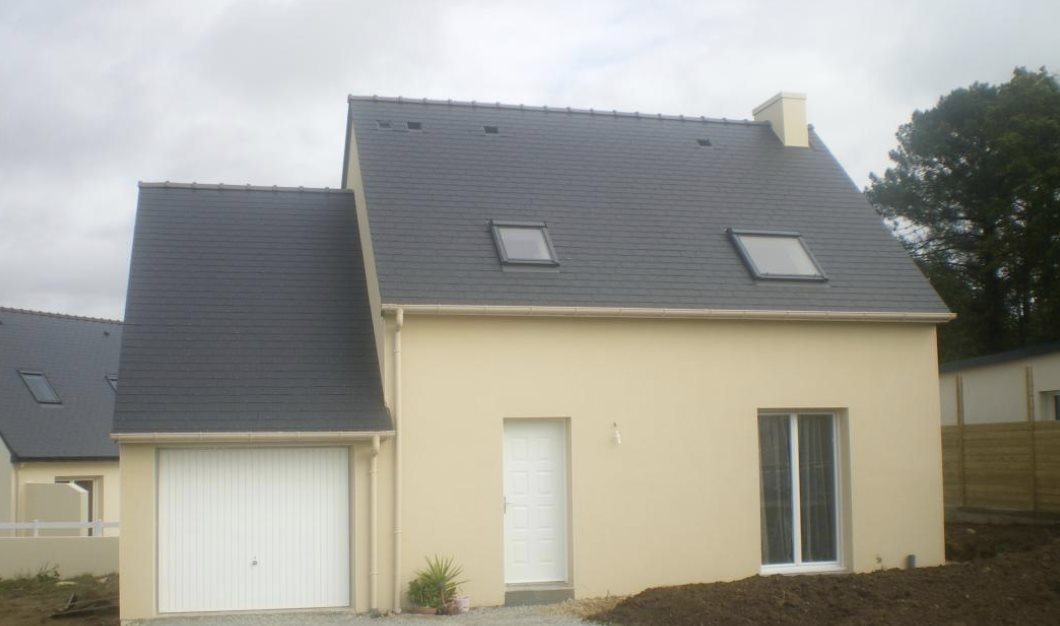
A brand new two-bedroom bungalow on its own plot starts at €170,000 all in, at Saint-Brice-de-Landelles. A three-bedroom starts at €173,072 at Romagny-Fontenay — the cheapest three-bedroom anywhere in our range, in any region. A four-bedroom house starts at around €194,000.
Those are complete figures: the land, the house finished and ready to live in, the notaire's fees, the connections. Nothing to add afterwards.
What that buys you, beyond the house, is a plot of a size that would be unthinkable nearer the coast, in a landscape that is genuinely beautiful, half an hour from one of the most famous places in Europe and forty-five minutes from the sea.
The honest caveat is that this is deep countryside. It rains — that is why it is this green — and the nearest town of any size is fifteen or twenty minutes away. If you want a café on the corner and neighbours at close range, look at Saint-Hilaire-du-Harcouët itself or further towards the coast. If you want space, quiet and a view, this is the best value in northern France and it is not close.
You can see what any specification comes to with our build cost calculator, and there is a fuller guide to living in Normandy covering the whole region.
We build across Brittany, Normandy and the Vendée, every house on a fixed inclusive price with the ten-year guarantee behind it. If the south Manche sounds like your part of France, tell us what you are looking for and we will suggest plots. Book a free half-hour, or reach us on WhatsApp or by email for a same-day reply.