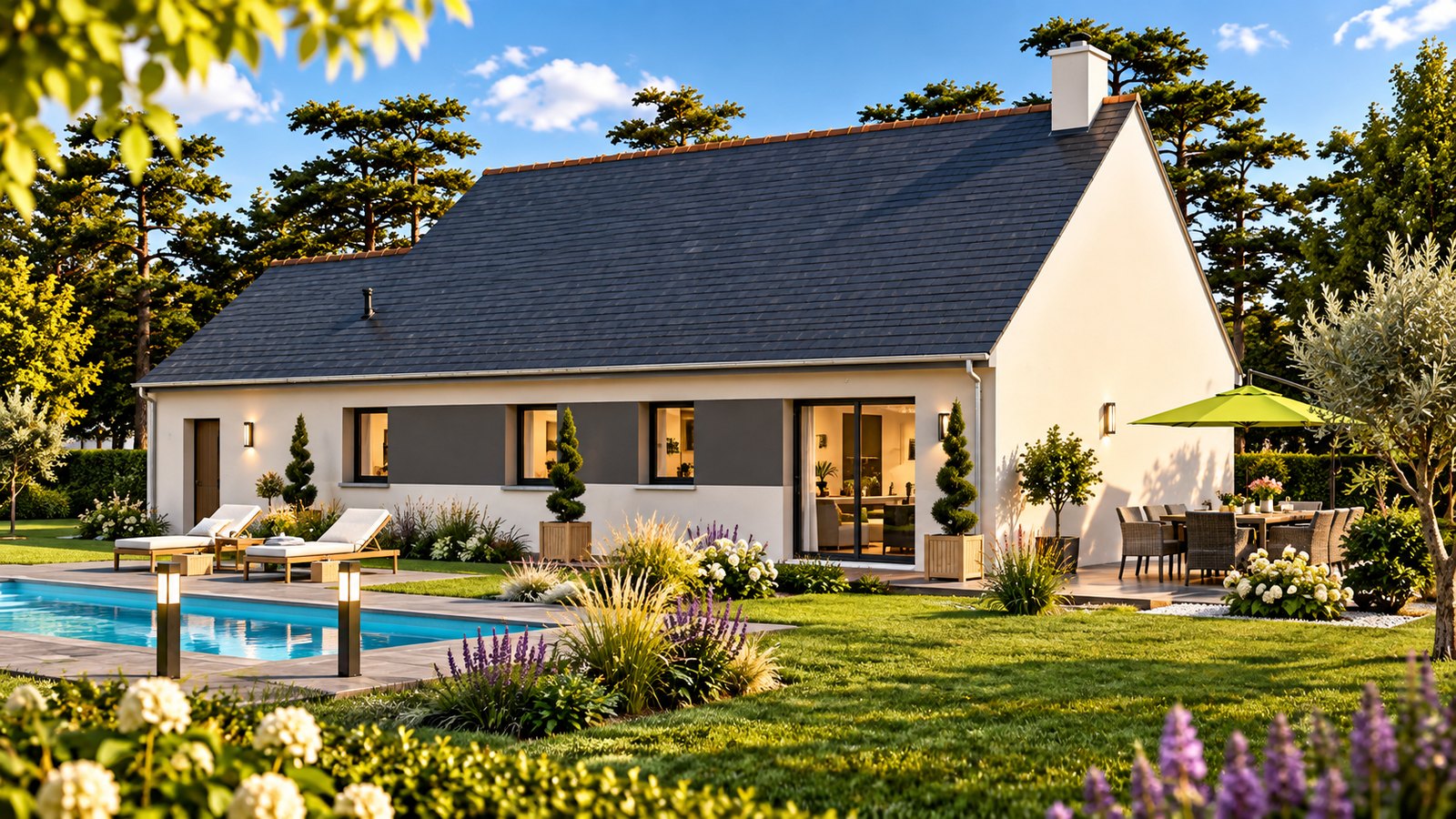
"New build" in France covers two completely different transactions, governed by different law, paid for on different schedules, and suited to different people.
Almost nobody explains the difference, which is why buyers often find themselves well down one road before realising the other existed.
One is VEFA, where you buy a finished thing from a developer before it exists. The other is CCMI, where you own a plot and commission a house to be built on it. Here is how each works and which one you probably want.
VEFA: buying something that has not been built yet
Vente en l'état futur d'achèvement — sale in a future state of completion — is the French off-plan purchase. A developer owns the land, has the permission, and sells units from a plan and a show flat.
It is overwhelmingly the way apartments are sold, and the way houses on developed estates are sold. If you are buying in a town, this is almost certainly what you are looking at.
What you sign. First a contrat de réservation, holding your unit, usually with a deposit. The deposit is capped by law and the cap falls the further away completion is. Then, some months later, the actual sale in front of a notaire, at which point ownership of the land share passes to you and the building becomes yours progressively as it goes up.
How you pay. The law caps what the developer may ask at each stage, and the ceilings are cumulative: no more than 35 per cent once the foundations are finished, 70 per cent once the roof is on and the building is watertight, 95 per cent at completion, and the final 5 per cent on handover of the keys.
That last five per cent matters. If you note reservations at handover and the developer disputes them, you can place the balance with the notaire or the Caisse des dépôts rather than paying it over, and it stays there until the reservations are dealt with. It is the only real leverage you have at the end, so do not hand it across casually.
The protection. A VEFA carries a garantie financière d'achèvement, a financial guarantee that the building will be completed even if the developer fails. The three construction guarantees — one year, two years and ten — run from delivery as they do on any new building.
What you control. Very little. You are buying a product. On some schemes you may choose finishes, tiles and kitchen units from a list, and perhaps move a partition. You do not choose the plot, the orientation, the layout or the neighbours.
CCMI: you own the land and commission the house
The contrat de construction de maison individuelle is the contract French law reserves for building one house on land that you already own. It is a consumer contract with terms written into statute, and the builder cannot contract out of them.
The sequence. You buy the plot first, with an ordinary compromis and acte at the notaire, usually conditional on the building permit being granted. Then you sign the CCMI, the permit is obtained, and the house is built.
How you pay. The percentages are set by decree and are cumulative ceilings, not a target. Three per cent on signature, against a refund guarantee, rising to five once the permit is in. Then 15 per cent at the opening of the site, 25 per cent with the foundations complete, 40 per cent with the walls up, 60 per cent once it is watertight, 75 per cent once windows and partitions are in, 95 per cent at completion, and the last 5 per cent at handover — which again may be held back against reservations.
The important word is complete. A stage has to be finished, not started, before the corresponding call can be made. A builder asking for money ahead of the stage reached is in breach, and it is the clearest early warning sign there is.
The protection. This is where the CCMI is exceptional. The price is firm and definitive and can only move in ways written into the contract. The delivery date is contractual, with penalties if it is missed. And the builder must hold a garantie de livraison — an insurance-backed guarantee that if they fail partway through, the guarantor appoints someone else and pays for your house to be finished at the agreed price.
On top of that sit the one, two and ten-year guarantees, and a ten-day cooling-off period after you receive the signed contract.
What you control. Nearly everything. The plot, the orientation, the layout, the specification, the garden, where the windows look.
The money difference nobody explains
This is the part that moves the sums, and it is rarely set out plainly.
In a VEFA you are buying a finished property, so the notaire's charges are calculated on the whole price. They are much lower than on an old house, because a new property is taxed differently, but they apply to the lot.
Under a CCMI you pay notaire's fees on the land only. The construction contract is a building contract, not a property sale, and it attracts no transfer duty at all. On a plot that represents a modest share of your total budget, that is a real saving, and it is one of the quiet reasons the plot-plus-CCMI route often works out cheaper than it first appears.
We have a separate article on what notaire fees actually are if you want the detail.
Where each one actually exists
Geography decides a good deal of this.
VEFA dominates where land is scarce and expensive — towns, cities, the coastal strips. Developers assemble sites, obtain permission and sell units, because that is the only economic way to build there.
CCMI is the rural and semi-rural route. Where individual serviced plots are available — across inland Brittany, Normandy and the Vendée, which is where we work — you can buy one and put the house you want on it. That is not an option in central Rennes and it is entirely normal in a commune of eight hundred people.
So in practice the choice is often made for you by where you want to live. If you want a village, a garden and a view, you are looking at a plot and a CCMI. If you want to be in a town, you are looking at a VEFA.
What goes wrong, in each
In a VEFA, the usual complaints are delay, and the gap between the show flat and the thing you receive. Completion dates slip, sometimes by a lot, and the contractual remedies are weaker than people expect. Take the handover seriously, list every reservation, and do not release the final five per cent until they are dealt with.
In a CCMI, the risks are different and mostly front-loaded. Choosing a builder on price alone, signing something that is not actually a CCMI, or accepting a contract where significant work is excluded and left for you to arrange — the dreaded travaux réservés — so that the "fixed price" is not the finished house. Check that the contract covers everything to a habitable state, and check that the garantie de livraison is genuinely in place.
If a builder offers you a contract that is not a CCMI for a single house on your own land, that is the moment to stop. The protections above are not optional extras; they are the whole reason the French system works.
Which one you want
Choose VEFA if you want to be in a town or want an apartment, if you would rather have no involvement in the building process at all, and if choosing from a list of finishes is enough control for you.
Choose a plot and a CCMI if you want a house rather than a unit, if the garden and the outlook matter, if you want a fixed price with a completion guarantee behind it, and if you would rather pay transfer duty on a plot than on a whole property.
For most people arriving from abroad and looking at rural western France, the second is both the available option and the better one. The fixed price in particular is worth more than it sounds when you are managing a project from several hundred miles away.
How we work
Everything we sell is a serviced plot plus a house under a CCMI, quoted as one inclusive price — the land, the house finished and ready to live in, the notaire's fees on the land, and the connections. There is nothing to add afterwards and the price is the price.
Behind it sits the garantie de livraison, the ten-year structural cover and the dommages-ouvrage policy arranged before anyone breaks ground. There is more on all of that in our guide to the ten-year guarantee and on our how we build page.
You can see what any specification comes to with the build cost calculator. We build across Brittany, Normandy and the Vendée — book a free half-hour, or reach us on WhatsApp or by email for a same-day reply.