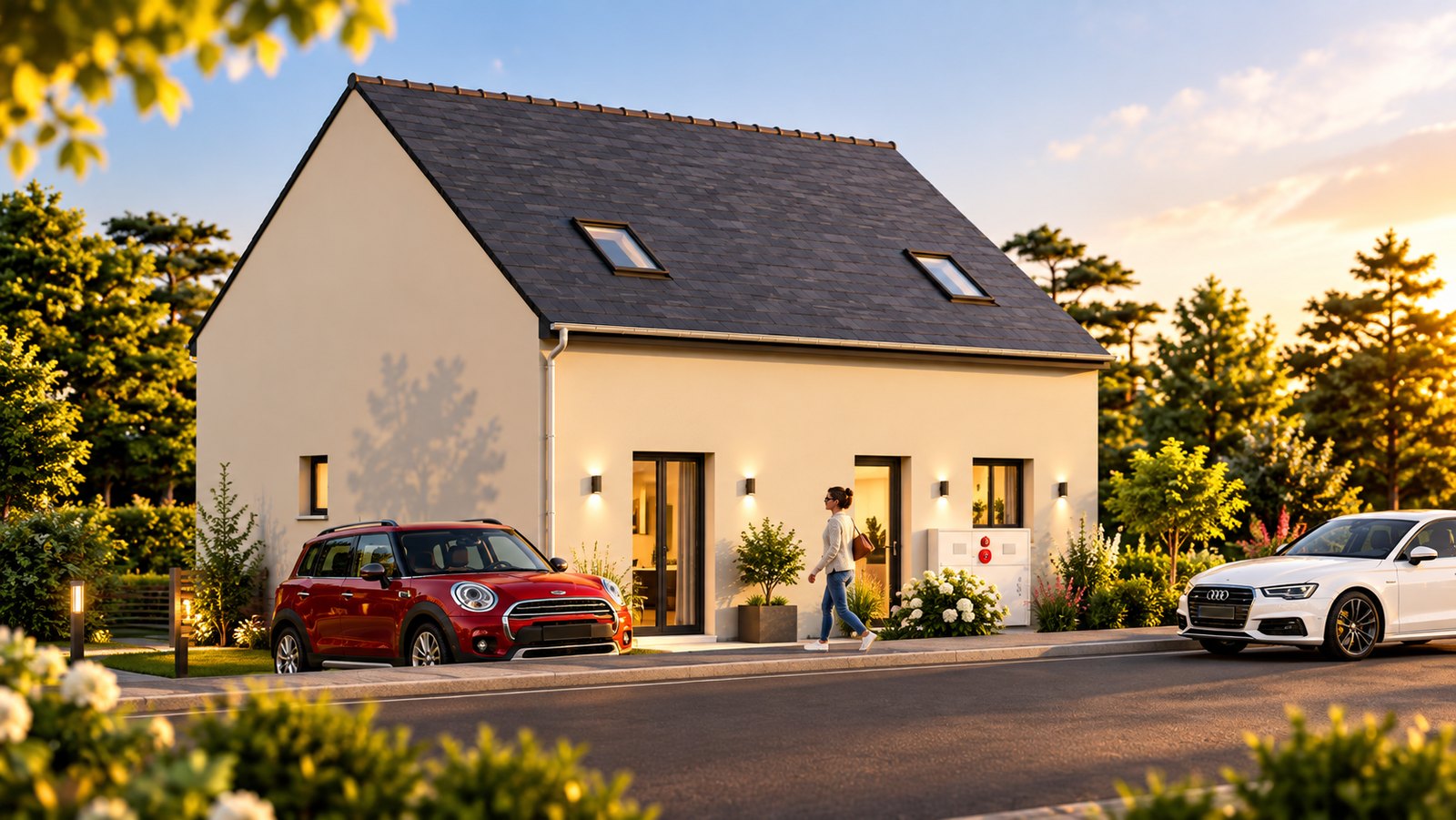
Somebody sends us a link most weeks. A plot of land, an hour inland, €22,000. Next to it, one of ours at nearly double that, and the question is always the same, politely put: why is yours so much more expensive?
Usually it is not. It is the same price or less. The difference is that ours is finished and theirs is a field.
This is the single most expensive misunderstanding in buying land in France, and it comes down to two words that sound similar and mean completely different things.
Constructible is not viabilisé
Constructible means you are allowed to build on it. The local plan permits a house there.
Viabilisé means the services are actually there — water, electricity, drainage and telecoms brought to the plot and ready to connect.
A plot can be perfectly constructible and have nothing on it at all. No water, no power, no drain, nothing but grass and a hedge. You are allowed to build, and before you can, somebody has to pay to bring all of that to the land. That somebody is you.
The gap between those two words is usually several thousand euros and several months, and occasionally it is very much more than that.
What each connection involves
Four networks, sometimes five, each with its own authority, its own quote and its own queue.
Water. You apply through the mairie, which passes it to the water service or whichever company holds the contract locally. For a plot sitting on the road with the main running past it, expect somewhere in the region of €800 to €2,500. The further the main is from your boundary, the more trench has to be dug in the public road, and the number climbs.
Electricity. This goes to Enedis, with your building permit, a site plan and the power rating you want. For a plot within about thirty metres of the network, roughly €1,500 to €3,000. Beyond that it rises with every metre of cable, and if you are asking for a heavier supply it rises again. Before they will switch you on, the installation inside the house has to be certified.
Drainage. If there is a mains sewer in the road, connecting to it commonly runs to somewhere between €2,000 and €5,000 once both the public and private sides are counted, and the commune may levy a charge on top for the privilege of joining. If there is no mains sewer, you are into an individual treatment system instead, which is a different budget and a different set of rules — we go through that in septic tanks in France.
Telecoms. Usually the cheapest of the lot, often a few hundred euros, and frequently done in the same trench as something else if you plan it properly.
Gas, where a network exists at all, which in rural Brittany, Normandy and the Vendée it very often does not.
Put together, servicing an ordinary plot that sits on a road with everything running past it tends to land somewhere between €5,000 and €15,000. A plot in an organised development where the services are already brought to the boundary sits at the bottom of that. An isolated plot, or one on a slope, or one where the nearest connection is two hundred metres away, sits at the top or well beyond it.
That is before any access track, any levelling, any retaining wall, and before the local taxes that come with building.
The trap inside the trap
Here is the one that catches careful people.
A plot can be advertised as serviced when the services are merely at the boundary — a water meter box and an electricity cabinet sitting on the edge of the land. That is not the same as having them where the house will be.
The public side of the work is handled for you. The trench from the boundary to your house is yours: your digger, your cost, and it is priced by the metre. On a narrow plot that is a modest job. On a plot where the house sits sixty metres back behind a stand of trees, it is not.
So the question to ask is never "is it serviced". It is "where exactly does each service stop, and how far is that from where the house will stand".
And one more, which people only discover at the worst moment: if the cable or the pipe has to cross land belonging to somebody else to reach you, you need that person's written agreement. A neighbour who is perfectly friendly at the viewing can be a great deal less friendly when a trench is proposed through their paddock.
The free document that answers all of this
Before you buy any bare plot in France, ask the mairie for a certificat d'urbanisme, and specifically the operational version.
It costs nothing. It takes a month or two. And it tells you what the planning rules are for that plot, whether what you want to build is permitted, where the networks are, how far away they sit, and frequently which taxes and charges will land on you.
It is the single best thing you can do before committing to land, and the number of people who skip it because the estate agent was reassuring is remarkable. The agent is not the one paying for two hundred metres of trench.
Get it in your hand before you sign anything, not after.
The cost nobody puts in the spreadsheet
Time.
The certificate takes one to two months. Quotes from each network take one to three. The physical connection work takes one to three more, longer if the road has to be dug up and the commune has opinions about when. The planning permission runs alongside all of this on its own two to three months.
None of that is unreasonable, and none of it can be hurried by being annoyed about it. But if you are paying rent somewhere else, or carrying a bridging loan, every one of those months has a price, and it rarely appears in anybody's calculation of what the bargain plot cost.
What this means for the plot you were comparing
Go back to the €22,000 field and add it up honestly. Say €10,000 to service it, if it is an ordinary plot in an ordinary position. Add the trench across your own land. Add the taxes. Add six to nine months of waiting before anyone can start building.
It is no longer €22,000, and it was never going to be.
That is not an argument that bare land is a bad buy. Sometimes it is an excellent one, particularly if the position is special and you are not in a hurry. It is an argument for knowing the real number before you commit, rather than discovering it a quote at a time.
How ours work
Our plots are serviced, and the connections are inside the price. Not "subject to quotation", not "to be confirmed" — in the figure. When we quote you a house and land package, that is the number, and it is on a fixed-price contract, so it is still the number at the end.
That is the whole reason we do it this way. Nobody arriving from another country should have to become an expert in French utility connections in order to find out what a house will actually cost them.
You can see what any of our plots come to, all in, with the build cost calculator.
And if you have found a plot of your own and want an honest opinion on what it would really take to build on it, send it to us. We will tell you what we think, including if the answer is that it is a bad buy. Book a free half-hour, or reach us on WhatsApp or by email for a same-day answer.