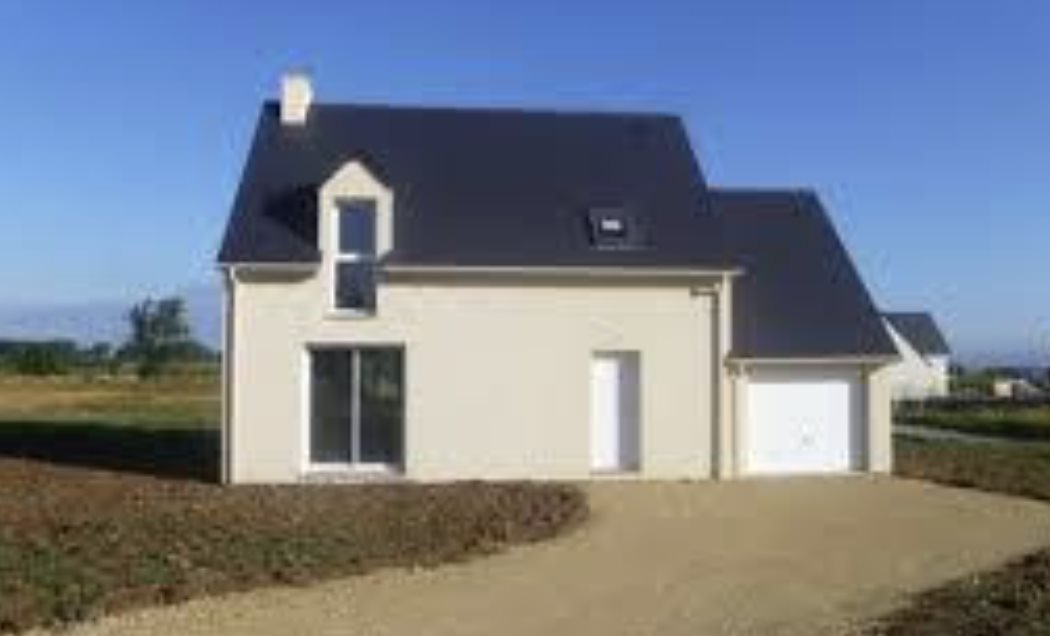
Most people looking at French property start with a budget rather than a map. They know roughly what they can spend and they want to know what it buys and where. That turns out to be an answerable question, because France publishes an unusual amount of price data and the gaps between one department and the next are enormous.
Here is what a square metre actually costs across the country in late 2026, which parts are cheap, and the thing the averages hide — which is that in several of the best-known departments a brand new house now costs less than the average second-hand one.
The market in one sentence
Nothing is happening, and that is the news.
INSEE's figures for the first quarter of 2026 show prices for older homes up 0.1 per cent across France over twelve months. Houses specifically were down 0.2 per cent. The only part of the country moving at all was Île-de-France, up 0.6 per cent on the year, and INSEE says plainly that the national rise was carried by Paris and its region alone. Across the provinces — which is everywhere else, and everywhere we build — prices were flat. Not falling. Not rising. Flat.
After two years of correction that is a settled market rather than a stalled one. For a buyer it removes the worst of the pressure: you are not racing a rising market, and you are not catching a falling knife either.
What a square metre costs
These are average prices per square metre for houses, taken from the main French price indices in October 2026. The national average for houses sits around €2,800.
Brittany. The Morbihan is the dearest of the four Breton departments at about €3,151, which is what happens when a department contains the Gulf of Morbihan. Ille-et-Vilaine is close behind at €3,027, pulled up by Rennes and Saint-Malo. Finistère is €2,777. And the Côtes-d'Armor — the north coast, Saint-Brieuc, the Côte de Granit Rose — is €2,328, well under the national average.
Normandy. Calvados is €2,797, which is Deauville and Caen doing their work. The Manche, the long peninsula running up to Cherbourg with the whole west coast facing Jersey, is €2,013. The Orne, entirely inland, is €1,354 — less than half the national average and among the cheapest departments in mainland France.
The Vendée. €2,914, with a coast that fills every summer and an interior that is remarkably quiet.
For comparison, Paris is €10,059. The Alpes-Maritimes is €5,665. Haute-Savoie is €5,190, the Var €4,664, the Gironde €3,688.
So the same money that buys forty square metres in Nice buys a hundred and sixty in the Orne, and about seventy-five in the Morbihan with the sea half an hour away.
What the averages hide
A departmental average is a blunt instrument and you should not plan around one.
Inside the Morbihan's €3,151 there is a coastal strip where houses go for well over €4,000 a square metre and an interior forty minutes inland where €1,800 is normal. The Manche's €2,013 covers both the sea-view cliffs near Granville and villages in the bocage where nothing has changed hands above €100,000 in years. Calvados looks expensive at €2,797 almost entirely because of Deauville.
The useful rule is that the premium is paid for the last twenty minutes of the drive to the water, and it is a steep one. Buyers who are willing to be half an hour inland, with the coast as a day out rather than a view, routinely pay forty per cent less for the same house.
That is the single biggest lever on a French property budget, and it costs nothing to pull.
Why the west is cheap
It is worth understanding, because it tells you whether it will stay cheap.
Rural France lost population for sixty years. The west lost more than most: farms consolidated, young people went to Rennes, Nantes and Paris, and the housing stock stayed where it was. There is simply more supply than demand across most of inland Brittany, Normandy and the Vendée, and that has not changed.
What has changed is the direction of travel. Since the pandemic the western departments have been net gainers of population, as people with portable work chose space and coast over commuting distance. Rennes and Nantes are both growing fast. The ferry ports are busy. None of that has translated into the price surges you see on the Mediterranean, but it does mean the long slide has stopped.
The honest read is that these are not distressed markets about to collapse further, nor markets about to run away. They are cheap for structural reasons that are slowly easing.
The comparison that actually decides it
Here is where the square-metre figures become useful rather than merely interesting, and it is the part most buyers never do.
A typical three-bedroom bungalow of the kind we build is about 85 square metres. Take that size and price it at the departmental average for an existing house, then add notaire fees of roughly eight per cent, which is what you pay on a second-hand property.
In the Morbihan that comes to about €289,000. In Ille-et-Vilaine, about €278,000. In the Vendée, about €268,000. In Calvados, about €257,000.
Now the new build. Our cheapest three-bedroom in inland Brittany is €182,000, and the middle of that range is €195,200. In Normandy, €173,072 and €185,000. In the Vendée, €189,000 and €197,467. Those are all-in figures — land, house, notaire fees, connections, everything, with nothing to add afterwards.
Read those two sets of numbers against each other. In Brittany, the Vendée and across most of Normandy, a brand new house on its own plot is costing materially less than the average existing house of the same size — before you have spent a euro on the existing one.
And the existing one is not finished. A house at the departmental average is a house of average age and average condition, which in rural France means a 1970s build with original windows and a DPE rating of E or F. The new one arrives rated A or B, under a fixed-price contract, with a ten-year structural guarantee and two years of taxe foncière exemption.
Where the old house still wins
The Orne, honestly, at €1,354 a square metre. An 85 square metre house there averages about €124,000 all in, and nothing new will touch that. If your priority is the lowest possible entry price and you are content to be deep inland in the Normandy bocage, buying what is already there is the right answer and we would tell you so.
The same applies anywhere you cannot build — a protected village centre, a seafront with no land left, a hamlet with no plots. And it applies if you genuinely want a renovation project rather than a finished house, which some people do and enjoy enormously.
What does not survive the arithmetic is the middle case: an average house at an average price in an average department, bought on the assumption that it must be cheaper than building. In most of the west, in 2026, it is not.
How to use these numbers
Three things are worth doing before you look at a single listing.
Pick your department by price before you pick it by photograph. The difference between the Orne and the Morbihan is not a difference in quality of life, it is a difference of nearly €1,800 a square metre, and you should know which one you are buying.
Decide what the coast is actually worth to you. Twenty minutes inland is a different market from the seafront, and the saving is large enough to change the size of house you can have.
And price the new build alongside the old one in the same department, all in, before you decide. People are routinely surprised, and the surprise usually runs one way.
You can see what any specification comes to with our build cost calculator — bedrooms, region, inland or coast, bungalow or house, and it returns a real figure taken from the plots that are actually for sale.
We build across Brittany, Normandy and the Vendée, and we hold serviced plots in all three. If you tell us your budget and what matters to you — coast or quiet, two bedrooms or four — we will tell you honestly what it reaches and whether building or buying makes better sense where you are looking. Book a free half-hour, or reach us on WhatsApp or by email for a same-day reply.