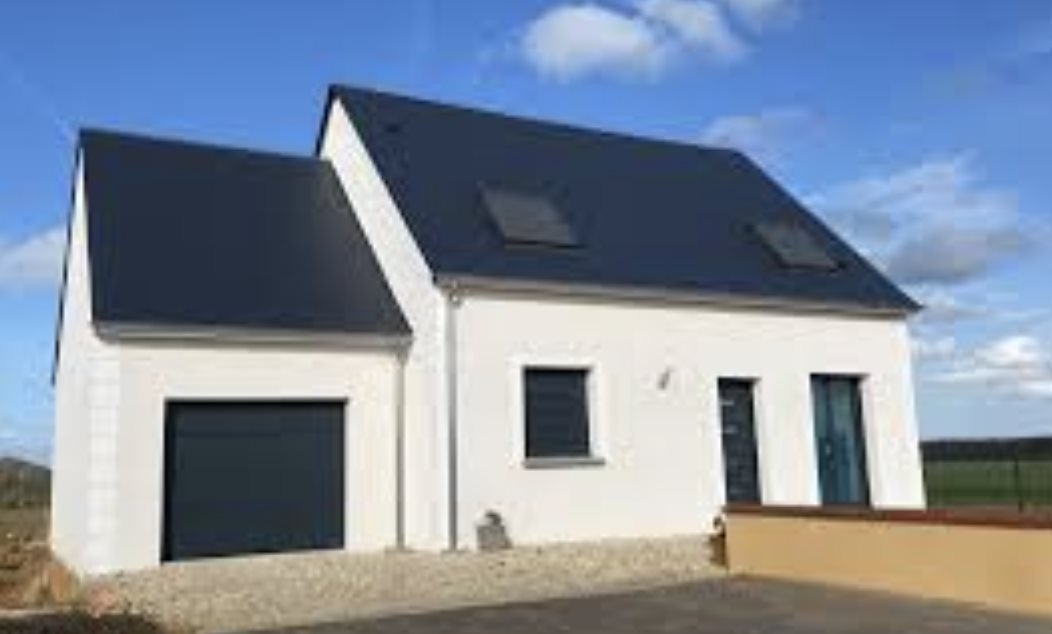
The cost of building the same house varies enormously across France. Not by a few per cent — by a third or more, for an identical set of plans.
If your budget is the thing deciding where you go, this article is the map. It is also a warning about the places that look cheapest on paper.
What you are actually paying for
A finished new house in France has four parts to its price, and only one of them is the house.
There is the construction itself. There is the plot, which varies more than anything else. There are the connections and groundworks — water, electricity, drainage or a treatment system, the access, the slab — which typically add 15 to 20 per cent on top of the bare construction figure and which nobody mentions in advertising. And there are the notaire's fees, which on a new build are low: roughly 2 to 3 per cent, because new property attracts reduced registration duty, against 7 to 8 per cent on an old house.
We price our packages all-in, as one figure, with the notaire estimated separately at the bottom. We deliberately do not break out what the plot costs, because once people start comparing land prices between two different communes they end up comparing two things that are not comparable — a serviced plot in a village with mains drainage against a field with nothing on it. The only number that means anything is what the finished house on its plot costs you.
Construction costs: what is normal in 2026
Across France this year, building a new house runs at roughly €1,700 to €1,900 per square metre for a standard specification, before the plot.
Within that:
An entry-level traditional build can come in around €1,300 per square metre. A mid-range specification sits around €1,600 to €1,950. Anything architect-designed and contemporary starts around €2,200 and climbs.
Under a CCMI, the regulated French builder's contract with a guaranteed price and a completion guarantee, the usual range is €1,400 to €2,200 per square metre.
The biggest single lever is the shape of the house. A bungalow costs about 20 per cent less per square metre than a two-storey house — no intermediate floor, no staircase, lighter foundations, simpler roof. That is why most of what we build in Brittany and Normandy is a bungalow, and why the Vendée costs more: plots there are smaller and planning pushes the footprint upwards, so the house goes up instead of out.
Regional labour costs move the figure too, and the west of France is on the cheaper side of the country. Building in Brittany or Normandy costs meaningfully less than the same house in Provence, the Alps or anywhere within commuting distance of Paris.
Where land is cheap and where it is not
Without quoting plot prices, the geography is easy to describe, because it follows one rule: distance from the sea and distance from a city.
The most expensive building land in the regions we work in is anywhere within about twenty minutes of the coast — the Gulf of Morbihan, the Emerald Coast around Saint-Malo, the Vendée seaside, the Cotentin beaches — and anywhere inside the commuter ring of Rennes or Nantes. In those places the plot can cost as much as the house.
Move half an hour inland and the picture changes completely. The same specification of house, in a village with a bakery, a school and a proper market town fifteen minutes away, can cost a third less all-in. You have given up a sea view you would look at from the window; you have kept a beach you can drive to in forty minutes.
The genuinely cheapest departments in France
If pure cost is the only criterion, the cheapest building land in the country is in the rural centre: the Creuse, the Indre, the Nièvre, the Cantal, the Haute-Marne, parts of the Haute-Vienne and the Allier. Land there can be a small fraction of the national average and the all-in cost of a new house is as low as it gets in France.
We do not build there, and it is worth being honest about why.
Those departments are losing population, in some cases steeply. Villages have lost their shop, their school and in places their doctor. There is very little local buyer demand, which means that when you or your family come to sell, there may be nobody to sell to at any sensible price. A cheap house in a department nobody is moving to is cheap for a reason, and the discount you enjoyed on the way in is the discount you pay on the way out.
For somebody who is certain they will never sell and who genuinely wants deep rural isolation, central France is extraordinary value. For most buyers it is a trap, and we would rather say so than sell you one.
Where the real value is: the cheap end of the popular regions
The sweet spot is the inland half of a region people actually want to live in. Cheap enough to matter; populated enough to resell.
The Orne (61) and southern Manche (50) in Normandy are the most affordable ground we work on. Gentle farmland, market towns every fifteen minutes, hospitals at Saint-Lô, Avranches and Alençon, and Cherbourg or Caen for the ferry. For a British buyer who wants to drive over for long weekends, nothing in France offers this combination at this price.
Inland Côtes-d'Armor (22) and inland Morbihan (56) in Brittany are the next step up and, to our minds, the best value in the country. Around Pontivy, Loudéac, Guémené-sur-Scorff, Josselin and Mohon you are twenty-five minutes from open countryside and under an hour from both the north and south coasts of Brittany, in towns that are busy all year, with the strongest inland economy in the west of France.
Inland Vendée (85), back from the resorts, is dearer than either — but it buys you the best climate of the three regions by a wide margin, and the deepest resale market, because French buyers want the Vendée too.
Our current prices for all three are on the house and land packages page, each with its own notaire estimate.
Five ways to cut the cost without cutting the house
Whatever department you choose, these make a real difference.
Build a bungalow if the plot allows it. Around a fifth cheaper per square metre than a two-storey house, and easier to live in as you get older.
Keep the shape simple. Every corner, bay and change of roofline costs money. A clean rectangle with a good roof looks better in ten years than a complicated one anyway.
Buy a plot that is already serviced. A plot with water, electricity and drainage at the boundary is worth paying for. A field without them can swallow €15,000 to €25,000 in connections and a treatment system before you have laid a brick, and you will not find that out until the quotes come in.
Leave the easy things to do later. The terrace, the driveway surface, the fencing, the carport, the garden. We finish the house properly and hand it over; several of our owners do the outside work themselves over the first summer and save thousands.
Build to the roof and finish the upstairs yourself, if your plot and plans suit it. A loft conversion done later, with the structure and the window openings already provided for in the original plans, is far cheaper than paying for a finished first floor on day one. We cover this in detail in our article on getting a new house in France for under €150,000.
How to think about it
The cheapest house in France is not the best-value house in France, and the gap between those two things is where people make their mistakes.
What you want is the least you can pay in a place that still has a shop, a school, a doctor, a market and somebody who would want to buy your house in fifteen years. In practice that is inland Normandy if money is tight, inland Brittany if you want the best balance, and the Vendée if the weather is the whole reason you are going.
Our free guide explains how the price is put together — the contract, the stage payments, the guarantees, and what is and is not included — so you can compare any builder's quote properly. Download it here; there is nothing to pay.
Construction cost figures checked in October 2026. Build costs and land values move; the prices on our listings are the current ones.