It is the question that comes up on every second call, and the honest answer has two halves.
The first half is what the energy costs, and that is a straightforward matter of published prices. The second half is how much of it your house needs, and that varies by a factor of ten between one building and the next. People spend a great deal of time on the first half and almost none on the second, which is the wrong way round.
Here are both, with the 2026 figures.
What each energy costs
These are the prices as they stood at the start of this winter, expressed as the cost of actually delivering one kilowatt-hour of heat into the room — which is not the same as the price of the fuel, because some systems waste far more of it than others.
A heat pump is the cheapest by a distance. At the regulated electricity tariff of 20.01 cents a kilowatt-hour, a well-set-up air-to-water heat pump delivers heat at around 5 cents, because it moves roughly four units of heat for every unit of electricity it draws. An average installation comes in nearer 6.9 cents. A badly set-up one — and there are plenty — falls to 11.1 cents, which tells you something about the importance of commissioning.
Logs are next, at about 8.3 cents for 40 cm lengths.
Wood pellets run at roughly 10.4 cents in bulk, or 10.7 cents in 15 kg bags.
Mains gas through a condensing boiler is about 16.2 cents.
Direct electric radiators are 20 cents — you pay for every unit and get exactly one unit back.
Heating oil is the most expensive at around 22.8 cents, with fuel at €1.94 a litre and a boiler losing about fifteen per cent of it up the flue.
The same house, six different systems
Put ten thousand kilowatt-hours of heat through a winter — a fair figure for an average, reasonably insulated French house — and the bill looks like this.
A well-adjusted heat pump: about €500. Logs: about €831. Bulk pellets: about €1,044. A poorly adjusted heat pump: about €1,112, which is more than wood. Mains gas: about €1,617. Electric radiators: about €2,001. Heating oil: about €2,279.
Those exclude standing charges, which are not trivial: roughly €190 a year for a 6 kVA electricity supply and around €360 a year for a gas heating contract.
So the gap between the best and worst way of heating the same house is about €1,800 a year, every year. Over a twenty-year ownership that is €36,000 in today's money, which is more than most people spend on the kitchen.
But the house matters more than the fuel
Here is the part that gets missed.
Ten thousand kilowatt-hours is a reasonable figure for a house that is reasonably insulated. A stone farmhouse in the Manche with no wall insulation, single glazing and a cold floor can easily want three or four times that. A new house built to the current standard wants a fraction of it.
That is why two neighbours in the same village with the same heating system and the same thermostat setting can be €2,000 a year apart. It is not the fuel. It is the fabric.
Which means the cheapest energy decision you will ever make is the one about the building, and you make it when you buy rather than afterwards.
The DPE, and a change most people missed
Every French property carries a DPE, the energy rating from A to G, and it is the quickest way to read a house's running costs before you own it.
It is expressed in kilowatt-hours per square metre per year of primary energy, and the number on the certificate is the useful part — more useful than the letter. The Paris apartment we have for sale, for instance, is rated E at 283 kWh/m²/year, which tells you considerably more than the letter E alone.
Something changed on 1 January 2026 that has barely been reported in English. The factor used to convert electricity consumption into primary energy for the DPE dropped from 2.3 to 1.9. In plain terms, electrically heated homes now score better on the certificate than they did a year ago for exactly the same consumption. Some properties will have moved up a letter without a single thing being done to them.
That matters in two directions. If you are buying, a recently issued certificate is not directly comparable with one from 2024. And if you own something sitting just the wrong side of a boundary — with the letting bans arriving for F in 2028 and E in 2034 — it may be worth having the DPE redone.
What an old rural house actually costs
We see the bills, because clients send them to us.
A typical unmodernised rural house of 100 to 130 square metres — stone or 1970s block, original windows, little or no wall insulation, oil or electric heating — commonly runs between €2,000 and €3,500 a year just for heating, and in a cold winter more. If it is on oil, it is at the top of that. If it is on direct electric radiators, it is not far behind.
That is the number people forget to add to the purchase price of a cheap house, and it recurs every year for as long as they own it.
What a new build costs
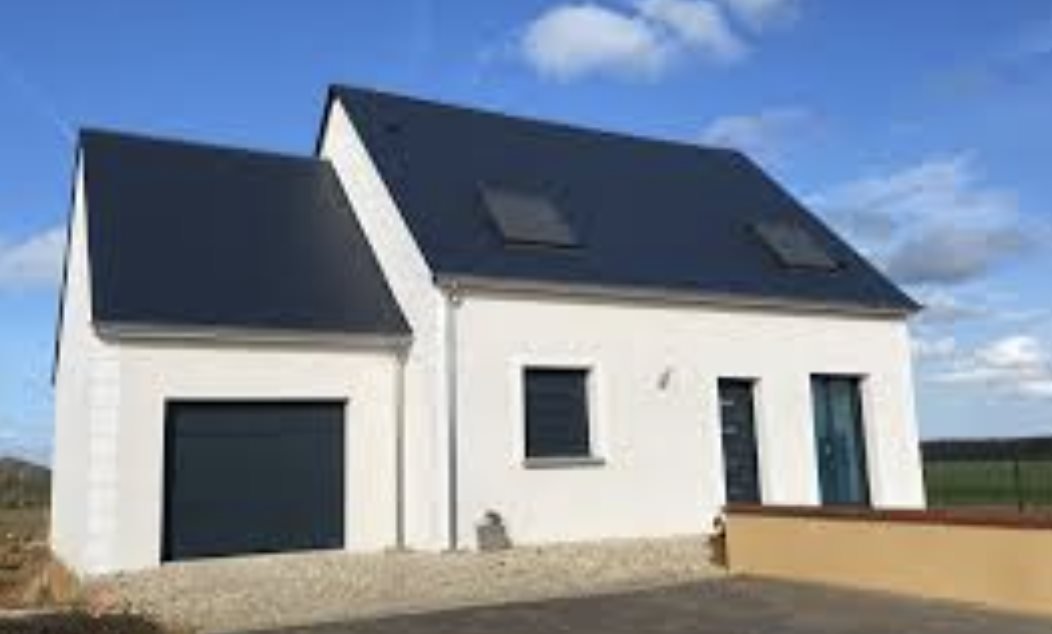
A house built to the current RE2020 standard is a genuinely different machine. Insulation in the walls, the roof and under the floor, triple-sealed joinery, controlled ventilation with heat recovery, no thermal bridges at the junctions, and a heat pump sized to a building that barely needs it.
For a two or three bedroom bungalow of the kind we build, heating typically comes out around €35 a month across the year. Not a winter month — an average month, including the cold ones.
Set that against €2,000 to €3,500 for the old house of a similar size and the difference is not a detail. It is €1,500 to €3,000 a year, which over the life of a mortgage is a serious sum, and it is the reason the running-cost argument has quietly become as strong as the comfort one.
It also protects you in a way nothing else does. Energy prices move, and nobody sensible forecasts them. A house that needs very little is insulated against the price of whatever it needs.
Wood, and the rural reality
In rural Brittany, Normandy and the Vendée, a great many houses have a wood burner, and a good proportion of the wood never appears in any statistic because it comes off the owner's own land or from a neighbour.
At 8.3 cents a kilowatt-hour for logs, wood is genuinely cheap, and as a supplement on the coldest evenings it is both pleasant and sensible. As a sole heating system it is a commitment: someone has to be there to light it, feed it and clear it, every day, through February.
If you are going to be in the house all winter, a burner in the living room alongside a heat pump is a good combination and a common one. If the house stands empty between October and April, it is a decoration.
What to check before you buy
Four things, and they take ten minutes.
Read the DPE number, not the letter, and note when it was issued.
Find out what the heating actually is and how old it is. An oil boiler of twenty years is a replacement waiting to happen, not an asset.
Ask the seller for a year of bills. They are not obliged to give them and most will. A refusal is itself informative.
Check whether mains gas exists in the commune at all. Across much of rural western France it does not, which quietly removes one of the options people assume they have.
Where we come in
Every house we build is a fixed-price CCMI turnkey build to the RE2020 standard with a DPE A rating, which is why the heating figure is what it is. We can tell you, before you commit to anything, what a specific design on a specific plot should cost to run — not a brochure figure, but one based on the houses we have already handed over.
You can see what any specification comes to with our build cost calculator, and there is more on what a turnkey build includes on our how we build page.
We build across Brittany, Normandy and the Vendée, every house on one inclusive price with the ten-year guarantee behind it. Book a free half-hour, or reach us on WhatsApp or by email for a same-day reply.