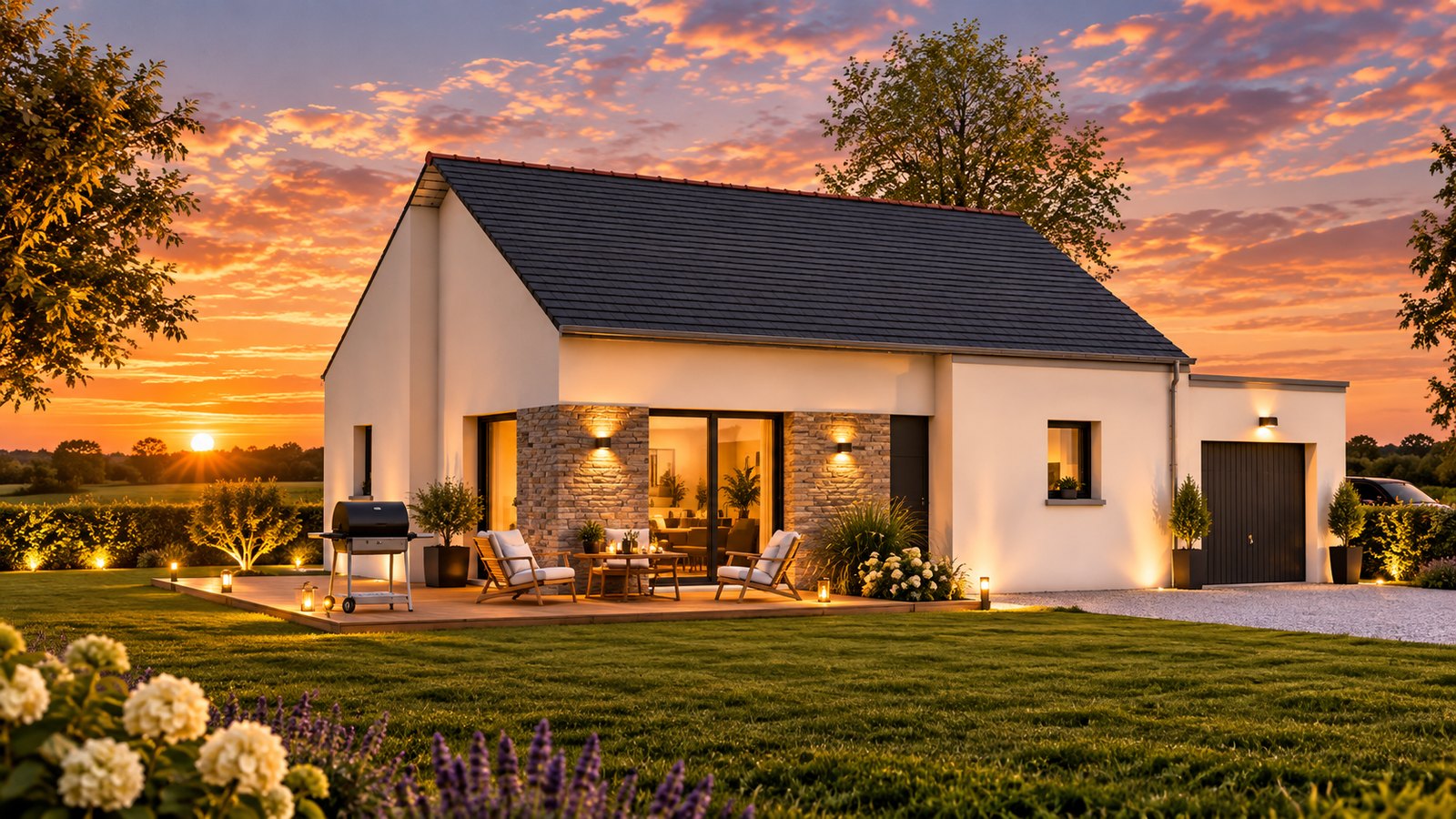
Sell a house in the United States for $500,000. Build a brand-new three-bedroom home with a garage, on its own plot, in one of the prettiest corners of Europe — and still have more than half the money in the bank.
That is not a sales pitch. It is arithmetic, and it is the single most surprising thing most Americans discover about building in France. This guide walks through how it actually works: the visa, the money, the contract, the timeline, and the honest math.
Start with the numbers
At the exchange rate in late September 2026, roughly $1.14 to the euro, a $500,000 house sale converts to about €440,000.
A brand-new three-bedroom bungalow with an integrated garage, on its own plot in rural Brittany, currently starts at €188,500 all in — land and house together, finished and ready to move into. Call it €200,000 to be comfortable. That is about $227,000.
Which leaves roughly €240,000, or $273,000, still sitting in your account.
That is the number that changes people's plans. It is not "downsizing." It is buying a better house, in a better place, and keeping the difference.
Why a new build, and not the stone farmhouse
Almost every American arrives looking for the 200-year-old stone longère with the beamed ceilings. Some buy one and love it. Most do the math halfway through and change course, for four reasons.
Closing costs. In France the notaire's fees — most of which is transfer tax collected for the state — run about 7 to 8% when you buy an existing property. When you build, the house is not being transferred to you; it is being built for you on land you already own. So those fees apply to the land only. On a €200,000 project where the land is €25,000, that is fees on €25,000 instead of €200,000. It is the largest single saving in building rather than buying, and almost nobody explains it.
Renovation. A French farmhouse that has not been touched since the 1970s needs rewiring, replumbing, insulation, usually a new roof covering, and very often a new septic system to meet current standards. Each is a five-figure job. Together they routinely exceed the purchase price, and you cannot cost them accurately until the walls are open.
Comfort. This is the one Americans feel most. A new French home is built to RE2020, the strictest building standard in Europe: heavy insulation, serious airtightness, triple-checked thermal performance, a reversible heat pump that heats in winter and cools in summer, and controlled ventilation. It earns a DPE energy rating of A, the top of the French scale, and costs around €30 to €35 a month to heat — all year. A stone house with single-skin walls can cost that in a week in February.
Risk. With a new build, the price is fixed by contract before ground is broken, and the house is insured for ten years against structural failure. With a renovation, the budget is an estimate and the guarantee is whatever your contractor's insurance turns out to cover.
One honest word about size
French homes are smaller than American ones, and you should know that going in. That three-bedroom bungalow is 85 m² — about 915 square feet. The median new American home is well over twice that.
But it is 915 square feet with no wasted circulation, on a plot that might run 890 m², roughly a fifth of an acre. And if you want American square footage, you can have it: a four-to-five bedroom house of 150 m², about 1,615 square feet, starts from €250,000 plus the plot. The point is not that you must live small. It is that you get to choose, and the choice is cheap.
The practical steps, in order
Step 1: Sort out the visa before anything else
This is the step Americans most often leave until last, and it is the one that sets the timetable.
As a US citizen you can spend 90 days in any rolling 180 in the Schengen area with no visa at all. Buying property grants you no additional right to stay — none. If you intend to live in France, you need a long-stay visa.
For most retirees and people living on savings or investments, that is the VLS-TS visiteur, the long-stay visitor visa. In outline:
- You must show stable income, benchmarked at roughly the French minimum wage per month, evidenced over three to six months rather than as a lump sum in an account. Social Security, pensions, rental income and dividends all count.
- You need private health insurance explicitly valid in France for the whole period. A standard US employer plan will not do, because it excludes care abroad.
- The visitor visa does not permit you to work in France — and France's position is that this includes remote work for a US employer while you are physically in France. If you plan to keep working, this is the wrong visa and you need different advice.
- Applications for US residents are decided by the French Consulate General in Washington DC and submitted through TLScontact centers. Reckon on four to six weeks from appointment to decision, and build in twelve weeks overall. Spring and early summer are the bottleneck.
- Within three months of arriving, you validate the visa online on the ANEF platform and pay a tax stamp. That converts it into your first-year residence permit. Missing this creates a status gap that causes real problems later.
Separately, the EU's Entry/Exit System for short stays is expected to come in during late 2026, with ETIAS following for visa-free travelers. Neither replaces a long-stay visa.
Step 2: Get the money organized
Open a French bank account early. You will need one for the notaire, the utilities and the taxes, and opening one from overseas takes longer than anyone expects. Start the month you start looking.
Think about the exchange rate as a decision, not weather. On a €200,000 project, a five-cent move in the dollar against the euro is around $9,000. A currency broker can fix a rate forward so that the dollar cost of each stage payment is known in advance. US retail banks rarely offer this and rarely offer a good rate.
Talk to a cross-border accountant before you move, not after. The United States taxes its citizens on worldwide income wherever they live. There is a US–France tax treaty, and it is generally favorable, but you will still file in both countries, and FBAR and FATCA reporting on your French accounts is not optional. This costs a few hundred dollars of advice and saves a great deal of grief.
Step 3: Choose where, with your eyes open
Brittany, Normandy and the Vendée are where the value is, and where we build. Green, rolling, deeply rural, with real towns — hospitals, markets, schools, train stations — rather than resort villages that empty out in October.
The practical checks: how far to a hospital, how far to a supermarket, how far to an airport with flights home, and does the village have a school and a bakery that open in February. A gorgeous hamlet forty minutes from a doctor is a different proposition at 75 than at 55.
On getting home: Rennes, Nantes and Brest all have international airports, and Paris is two to three hours by TGV from much of western France, with direct flights to a dozen US cities.
Step 4: Find the plot — and check its paperwork
In France, land is either constructible, zoned for building, or it is not, and nothing about how it looks tells you which. The document that settles it is the certificat d'urbanisme. Ask for it. Never buy on a verbal assurance.
The two other things that change the budget: whether the plot is serviced — water, electricity, telecom and drainage already brought to it — and whether there is a municipal sewer. Where there is not, an individual septic system runs around €12,000, designed and approved. Bringing services to an unserviced plot runs €7,000 to €8,000. We establish both in writing before you commit.
Step 5: The contract — and why it is better than anything you have signed at home
Your building contract will be a CCMI, the contrat de construction de maison individuelle. It is compulsory in France where a company builds a house on land belonging to the client and supplies the plans, and it is the most protective construction contract in Europe. Americans consistently underestimate what it does.
The price is firm and final. If materials rise, if the ground turns out to be harder than expected, if a subcontractor goes under, that is the builder's problem. There is no change-order culture. The only thing that changes the price is a change you request, agreed in writing.
You pay behind the work, never in front of it. The law sets the maximum payable at each stage: 15% at the start on site, 25% at foundations, 40% at walls, 60% once the roof is on, 75% at windows and partitions, 95% at fit-out, and the final 5% at handover — which you can hold back until anything noted on the day is fixed.
Somebody guarantees that your house gets finished. Before ground is broken, the builder must give you a garantie de livraison: a certificate from a bank or insurer, in your name, guaranteeing delivery at the agreed price and on time. If the builder fails halfway through, the guarantor hires another company and pays for your house to be completed. There is no American equivalent, and it is the best single reason to build here rather than there.
Ten years of structural insurance. Dommages-Ouvrage pays to fix a structural defect immediately, without waiting for anyone's fault to be established in court, and it runs with the house if you sell.
And ten days to change your mind. Once the signed contract reaches you, you have ten days to withdraw, for any reason or none, with nothing lost.
Step 6: The permit, and the part nobody mentions
A new house needs a permis de construire. The town hall has two months to decide. Then the permission is posted on the plot, and third parties — realistically, future neighbors — have two more months to object. Only when that window closes unchallenged is it safe to start. Anyone willing to break ground before then is telling you something about how they work.
Step 7: The build, and then the keys
Construction runs eight to twelve months. Foundations, walls, roof, weathertight, then the long invisible months of the interior. You do not need to be in France for any of it; we send photographs and updates, and you can give the notaire a power of attorney so no signature waits on a flight.
Total, from choosing a plot to holding the keys: twelve to eighteen months.
What you will pay every year
Taxe foncière, the property tax, which is modest by American standards and exempt for the first two years on a new build. Taxe d'habitation was abolished on main homes; it still applies to second homes. Heating, at roughly €30 to €35 a month. And after three months of stable residence you can apply to join the French health system, which is among the best in the world and a fraction of what you are paying now.
One more, so it is not a surprise: the taxe d'aménagement, a one-off development tax that arrives about ninety days after the house is finished. On a 75 m² main residence it is typically €1,800 to €2,500. We calculate yours and give it to you before you sign.
Now the fun part: what the rest of the money does
Here is where the American dream in France stops being a phrase and becomes a spreadsheet.
You have built the house for €200,000. You are sitting on roughly €240,000. In France, that buys:
A boat. Brittany has more coastline than any other French region, and marina berths in the Morbihan, along the Emerald Coast and on the Gulf cost a fraction of Florida or New England.
The camping-car. Europeans take RVs seriously, and France has thousands of dedicated aires — overnight stopping places, many of them free or a few euros, in the middle of villages you would never otherwise find.
And the continent, which is the real prize. From western France you can drive to the Loire châteaux in two hours, Bordeaux and the wine country in five, the Pyrenees in seven. Budget flights from Nantes, Rennes and Paris put Rome, Athens, Lisbon, Stockholm and Helsinki within two or three hours and often under $100 return. Italy and Greece in the spring; Norway, Sweden and Finland in the summer for the long light; Spain and Portugal when the weather turns. No visas, no border queues, no jet lag — twenty-nine countries on your doorstep.
Americans routinely spend $8,000 on two weeks in Europe. From a house in Brittany, that is a long weekend.
Why work with us
Building in a foreign country, in a foreign language, under a legal system you have never met, from six time zones away, is the part that stops most people. That is the part we do.
We are bilingual and we are here. Not a website with a contact form — people on the ground in Brittany, Normandy and the Vendée who go and stand on the plot.
One point of contact for the whole thing. The land, the notaire, the design, the permit, the builder, the utilities. You do not assemble a team of strangers across an ocean; you talk to us, and we chase everyone else.
We do not stop at the keys. This is the part that surprises people most, and it is the part that matters most once you are actually here. Handover is not the end of the job — it is roughly the halfway point of what we do for you.
Buying a car and getting it registered. Car insurance and home insurance. Setting up the electricity, the water, the internet and a French phone. Registering with a doctor and a dentist, and getting into the health system. The tax forms in the first year. Finding a school, a plumber, a gardener, someone who can fix the lawnmower. Understanding the letter that arrived in French and looks official.
We do all of it with you, in your language, for as long as it takes to get you properly settled — not for thirty days, not until the invoice clears. And we are on the end of a phone seven days a week. Nobody moves to another country and has no questions; the difference is whether there is somebody to ask.
We keep it organized, and we keep you ahead of it. Every stage has a deadline, and most of the ways a French purchase goes wrong are simply somebody missing one. You get told what is happening, what is next and what we need from you, before it becomes urgent — not after.
No surprises on money. Every price on this site is all-inclusive and fully turnkey. Everything that sits outside it — the notaire's fee on the land, the development tax, servicing where a plot needs it — is established in writing before you commit to anything.
Thirty-seven years and more than 1,200 projects. We have done this often enough to know where it goes wrong.
Real houses, real prices
Every package on our Available Homes page pairs an actual plot with an actual house and quotes one all-inclusive figure, sorted by region. Three-bedroom bungalows with an integrated garage currently start at €188,500 in Brittany.
If you would rather read the whole thing before speaking to anyone, our free guide — Building a New Home in France — covers the contract, the costs, the guarantees and the timeline over thirty-two pages, with a checklist you can print.
And when you are ready to talk it through, we will work around your time zone, not ours.