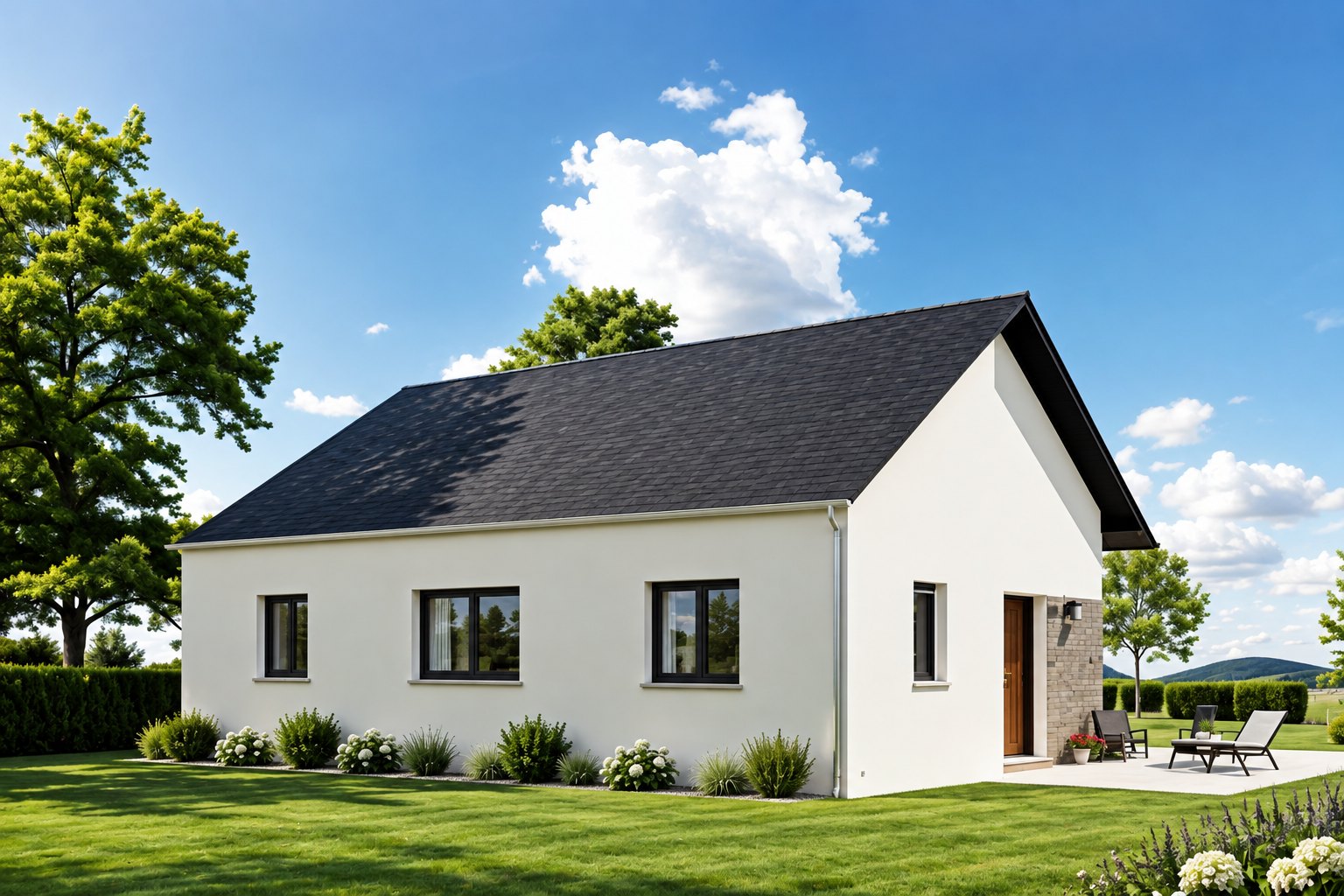
Almost everybody who contacts us has already narrowed it down to three places: Brittany, Normandy or the Vendée.
Nobody can ever tell them which one to pick. Estate agents are loyal to whichever region pays them. Forums fill up with people defending the place they already bought. So here is a straight comparison from a company that builds in all three and has no reason to push you towards any of them.
The short answer
If you want it in one line each:
Normandy is the cheapest and the closest to Britain. Choose it if budget and ferry time matter most.
Brittany is the best all-rounder. Choose it if you want coast, a real local economy and the biggest choice of towns.
The Vendée has the best weather by a clear margin. Choose it if sunshine is the reason you are leaving.
Now the detail behind those three sentences.
Weather: the Vendée wins, and it is not close
This is the one thing people get wrong, because they imagine the whole of northern France is much the same.
Brittany gets around 1,700 hours of sunshine a year and roughly 930 mm of rain. Normandy is very similar — around 1,750 hours of sun, a little drier at about 790 mm, and about a degree cooler. Both are mild, green and damp, in the way the west of England and the south of Ireland are mild, green and damp. Frost is rare. Snow is an event.
The Vendée is in a different league. La Rochelle, just down the coast, records well over 2,000 hours of sunshine a year and is one of the sunniest spots on the entire Atlantic seaboard. The Vendée coast is a proper summer holiday climate — hot July and August, long warm evenings, and a shoulder season either side that genuinely feels like a season rather than a disappointment.
If you have spent thirty years in Britain or Ireland waiting for the summer to turn up, that difference is not a detail. It is the whole point.
The trade-off is that the Vendée is busier in August and quieter in February, because it is a holiday coast. Brittany and Normandy are more even across the year.
Getting there: Normandy wins
For British buyers the ferry map decides a lot.
Normandy is the closest point of France that is not Calais. Portsmouth to Caen or Cherbourg is an overnight crossing, and from Cherbourg you are in the Manche or the Orne within an hour or two. For anyone keeping family ties in the south of England, nothing beats it. Several of our Normandy owners drive over for a long weekend without thinking about it.
Brittany is two crossings — Portsmouth or Plymouth to Saint-Malo or Roscoff — and once you land you are already in the region. Saint-Malo in particular is a lovely place to arrive. Add an hour or two of driving for the inland departments.
The Vendée needs more planning. The nearest useful ports are Saint-Malo or Roscoff and then three to four hours south, or Cherbourg and a similar run. Nantes airport is the sensible answer for flights, and there is a TGV from Paris to La Roche-sur-Yon and Nantes if you are coming by train.
For Irish buyers the picture shifts. The direct sailings from Dublin, Rosslare and Cork all land at Cherbourg or Roscoff, which puts Normandy and Brittany on your doorstep and the Vendée a half-day drive beyond.
Price: Normandy is cheapest, the Vendée coast is dearest
We are talking here about the all-in price of a new house with its plot — not land on its own, which tells you very little.
Inland Normandy — the Orne, the south of the Manche — is the most affordable ground we work on. Building land is plentiful, villages are not under pressure, and the same house costs noticeably less there than it does within sight of the sea anywhere else.
Inland Brittany is next. The Morbihan and the Côtes-d'Armor away from the coast are very good value, while anything within twenty minutes of the Gulf of Morbihan or the Emerald Coast climbs steeply.
The Vendée is the most expensive of the three, and the closer you get to the coast the sharper it gets. It is also where we build the two-storey model rather than a bungalow, because plots are smaller and planning rules push the footprint upwards.
Our current prices for each region are on the new build packages page. They move, so there is no point quoting figures in an article you might read next year.
Pace of life and what is actually open in winter
This is the question nobody asks and everybody later wishes they had.
Normandy is agricultural, dispersed and quiet. Market towns of five to fifteen thousand people, a good hospital network, and very little that is seasonal. What is open in July is open in January. If you like a gentle, ordinary, year-round rhythm, Normandy delivers it.
Brittany has the strongest identity of the three and the healthiest inland economy. Towns like Pontivy, Loudéac, Redon and Josselin have proper high streets, markets, schools, clinics and clubs that function all year. Brittany is also where you find the most organised foreign community — not an expat bubble, but enough English and Irish faces at the rugby club or the choir to make the first winter easier.
The Vendée is the most seasonal. On the coast, some restaurants and shops close from October to Easter and the population of a resort town can fall by three-quarters. Ten or fifteen minutes inland this evens out, and La Roche-sur-Yon, Luçon and Fontenay-le-Comte are busy working towns throughout the year. Many of our Vendée buyers deliberately build a short drive back from the sea for exactly that reason: you get the climate without the ghost-town February.
Language
All three are France, and you will need French. But the pressure differs.
In the Vendée and on the Brittany coast, tourism means more people with some English. Inland Normandy and inland Brittany are the opposite: you will be the only foreigner in the queue at the boulangerie, which is harder for three months and much better for three years. People who learn French fastest are the ones who had no choice.
Resale
If you ever need to sell, the order roughly reverses the price order.
The Vendée coast has the deepest buyer pool — French holiday buyers, Parisians, retirees from all over the country — and a modern, efficient, RE2020 house with a garden sells there readily. Brittany's coast is similar, with Saint-Malo and the Gulf of Morbihan the strongest markets in the region.
Inland Normandy is the slowest market of the three. That is the other side of the cheap entry price, and it is worth knowing before you choose purely on cost. A new house still sells far more easily than a draughty old longère needing a roof, but you should not buy inland Normandy expecting to flip it in a hurry.
How we would actually advise you
Over the years, the pattern we see is this.
Buyers who are still working, or who have family they want to see often, do best in Normandy or northern Brittany, where the ferry run is short enough that nothing feels like an expedition.
Buyers who are retiring properly and who want the sun do best in the Vendée, and almost never regret the longer journey once they have made it a handful of times.
Buyers who are not sure — which is most people — do best in inland Brittany. It is the middle of every one of these arguments: decent weather, reachable, affordable, lively all year, good schools, good hospitals, and plenty of coast within an hour when you want it. It is where we have built the most houses, and it is where we send people who genuinely cannot decide.
Before you choose, go in February
The single best piece of advice we can give costs the price of a ferry ticket.
Visit your shortlist out of season. Anywhere in France is charming in June. Go in February, in the rain, on a Tuesday. See what is open, how far the supermarket is, whether the town feels alive, whether you can imagine the dark end of the afternoon there. Everyone who does this makes a better decision, and a few change regions entirely.
Our free guide covers how the build itself works wherever you end up — the contract, the stage payments, the guarantees and the timeline. You can download it here, and there is nothing to pay.
Climate and travel information checked in October 2026. Prices change; the figures on our listings pages are the current ones.